Welcome to The EV Hub

EVs (electric vehicles) are the future - but the fast evolving industry brings a bewildering amount of confusing information. We're here to provide clarity where you need it the most: to help you make an informed decision about what form of EV ownership is right for you. We cut through the noise to show you what matters the most.

Is an EV Right for me?

What do you really need to know about electric cars? Take your first step towards EV ownership with these introductory guides.

Electric Car Running Costs

Getting your hands on an electric car is only half the battle. Keeping it on the road is just as important. Find out how in these guides.

Electric Car Advice

If you need help finding an electric car, you're in the right place. Check out these guides for advice on choosing and buying an EV.

Electric Car Practicality

Don't discount the practical benefits of an electric car, especially if you live in an area with a CAZ, LEZ or ULEZ. Find out more here.

Electric Car Subscription

An electric car subscription is an exciting new form of flexible EV ownership. Interested? Learn more about it in these guides.

Electric Car Charging

Charging an electric car is cheap, convenient and easy. Plug into these guides to learn all you need to know about charging an EV.

Petrol & Diesel Cars (ICE) Vs Electric Cars: What's the Difference?

Electric cars aren't just different to ICEs because they run on a battery power rather than fossil fuels. Other big differences include:

  • Electric emissions. Electric cars produce 0 exhaust emissions. Even the cleanest hybrid or ICE can't match that due to the Carbon Dioxide (CO2) produced during combustion.
  • Fewer charges. Electric cars are exempt from the Congestion Charge, ULEZ (Ultra-Low Emission Zones) and LEZ (Low-Emission Zones) as well as road tax.
  • The driving experience. All EVs use a single speed drivetrain and are fully automatic. This means they have much more torque at lower speeds, allowing for faster and smoother acceleration. They are also much quieter because the batteries produce far less noise than a standard engine.
  • Refuelling. You can charge an EV at home rather than using a petrol station.
  • The number of moving parts. EVs have 90% fewer moving parts than ICEs.
  • Range. Electric cars have a shorter range than ICEs because of the way batteries work. This increases the number of stops you need to make on a long journey and makes recharging much longer as well.

Hybrid Vs Electric Cars: What's the Difference?

While some hybrid cars can run on battery power alone, their range is much shorter than a pure electric car. In many cases, the battery is only there to make the engine run more efficiently.

Petrol & Diesel (ICE) Cars
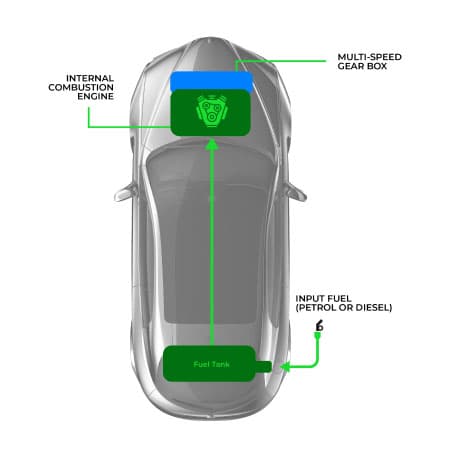
A Diagram showing how an ICE car works

Electric Cars

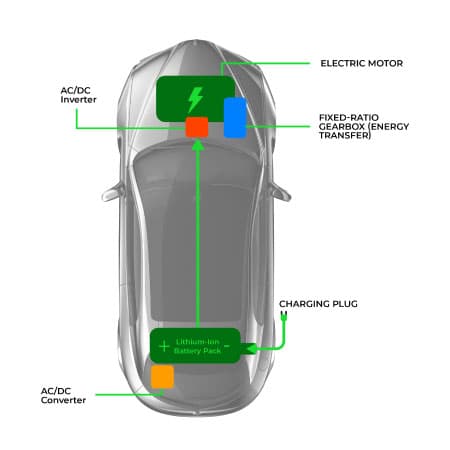
A Diagram showing how an electric car works

Hybrid Cars

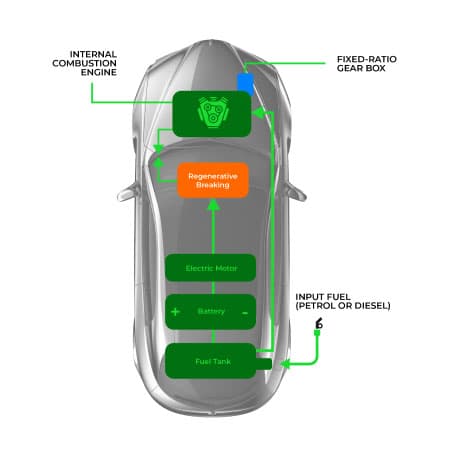
A Diagram showing how a hybrid car works
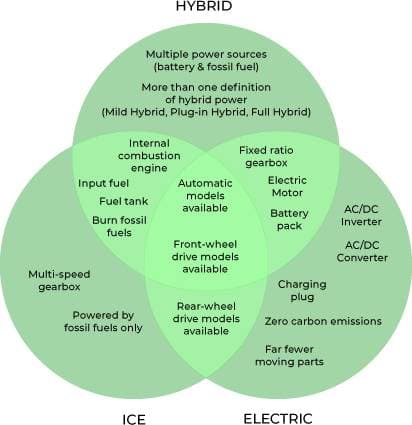
A Venn Diagram showing the differences between ICE, Electric and Hybrid cars

A hybrid car is fitted with an internal combustion engine, an electric motor and a battery pack. These work together to make a hybrid more efficient than a pure ICE. However, because of the presence of fossil fuels, they are not as environmentally friendly as electric cars. Mild hybrids also cannot run on battery power alone.

Book a service for your electric vehicle.

Compare instant prices from specialist EV garages near you and book an electric car service today.

FAQs

Do Electric Cars Need to Pass an MOT?

The MOT becomes a legal requirement for electric cars as soon as they turn three years old, just like any petrol or diesel car. This means that you need a valid MOT certificate at all times to keep driving your 3+-year-old electric car.

The only difference is that an electric car doesn’t need to pass any of the emissions or noise tests.

Read More: Electic Car Servicing

Can You Charge an Electric at Home?

You can charge your electric car at home, provided that you have a fast-charge wall box installed at your house and somewhere to park your car while it charges.

While you can charge an electric car at home using a standard 3-pin home charger, you should only do this in an emergency. Not only is it inefficient, but you can also overload the plug socket and damage your vehicle.

Read More: How Much Does it Cost to Install an Electric Car Charger in the UK?

Are Electric Cars Exempt From the Congestion Charge?

Electric cars are exempt from paying the London Congestion Charge. They are zero-emissions vehicles and so are eligible for the Cleaner Vehicle Discount. This allows you to drive in London without worrying about paying any daily charges.

However, you must register your car with Transport For London (TFL) first. Otherwise, you may receive a fine.

Read More: Do I Need to Register My Electric Car For the London Congestion Charge?

Can an Electric Car Tow a Caravan?

Yes, an electric car can tow a caravan. In fact, those designed for this job are more suited to the task than petrol or diesel cars due to the instant torque the electric motors provide and the fact that electric cars are heavier.

However, only a few electric cars are actually approved to tow a caravan or trailer as it can significantly affect the battery’s range.

Read More: Can Electric Cars Tow a Caravan?

Does an Electric Car Need Less Maintenance Than a Petrol/Diesel Car?

An electric car has up to 90% fewer moving parts and no oils or fluids to top up and maintain. However, you still need to change the tyres, service the air conditioning system, replace the brake fluid, brake pads and brake discs at regular intervals and book a service once a year

Overall, this means that an electric car requires roughly the same level of maintenance as the average ICE but you don’t need to take it into a garage as frequently. This often saves you money on maintenance costs.

Read More: Electic Car Servicing

When Will All Cars in the UK Be Electric?

The UK Government has set a net-zero emissions target of 2050. This means that all cars will need to be 100% electric by this date.

The first step on this journey is the 2030 ban on the sale of new petrol and diesel vehicles. You won’t be able to buy new hybrid vehicles after 2035 either. You will only have the choice of battery or hydrogen-powered vehicles.

Read More: When Will All Cars Be Electric in the UK?

How Do You Dispose of an Electric Car Battery?

Companies that sell lithium-ion batteries are responsible for their disposal. If you are looking to get rid of an old electric car battery, you must dispose of it safely with an authorised company.

You must not dispose of an electric car battery in your household waste.

Are Electric Cars Better For the Environment?

Electric cars are zero-emissions vehicles, so driving one is much better than driving a petrol or diesel vehicle. This is because they don’t produce any tailpipe emissions, such as Carbon Dioxide (CO2) or Nitrous Oxides (NOx). These are the main contributors to Climate Change.

However, the manufacturing process is no greener than making any other car, charging an electric car uses electricity produced by burning fossil fuels and there are big issues with the production and disposal of electric car batteries. This means that many people consider electric cars no better for the environment than petrol or diesel cars.