Looking for ways to improve your car’s fuel economy?
Fuel efficiency measures how far your car can travel with a certain amount of fuel.
By adopting the fuel-efficient driving habits mentioned in this blog, you can help to reduce your vehicle’s fuel consumption.
Page Contents
How to Improve the Fuel Efficiency of Your Car
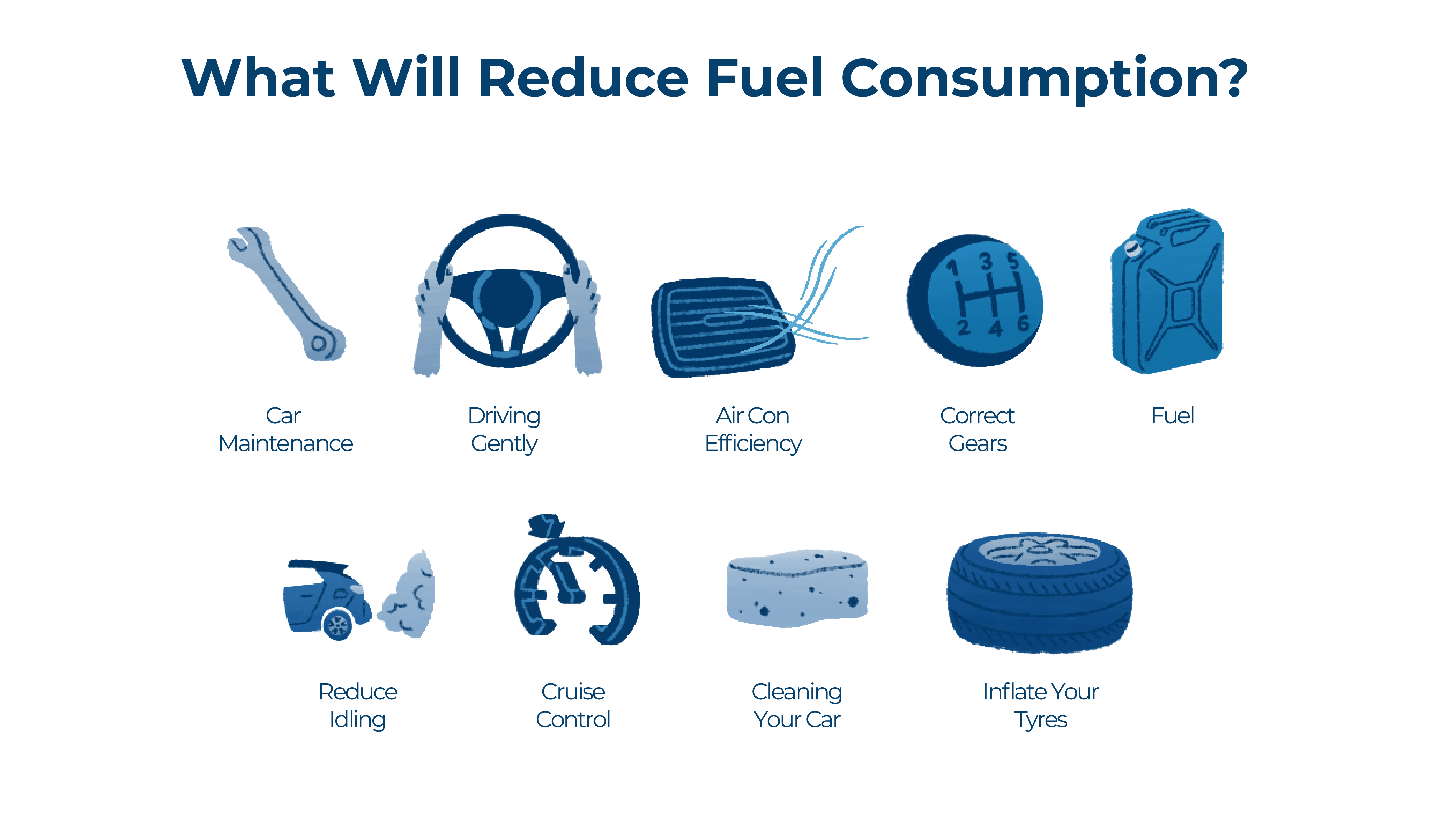
To improve your car’s fuel efficiency, you can do the following:
- Invest in regular car servicing
- Drive gently
- Use air con effectively
- Use the right gears
- Fill up only the fuel you need
- Minimise idling
- Save cruise control for the motorway
- Clean out your car
- Properly inflate your tyres
- Book regular oil changes and air filter replacements
- Book a diagnostic check
- Keep your wheels aligned
- Avoid excessive speeds
- Increase your following distance
- Switch off the engine when at a standstill
Fuel efficiency can vary depending on the type of vehicle you drive, the engine type, driving conditions, and the speed you travel at.
Finding the cheapest fuel in your area and monitoring how you drive can have an impact on fuel consumption.
If you’ve calculated your mpg and you aren’t happy with your fuel consumption, try driving when there’s less traffic or running multiple errands in a single trip.
Keep in mind that fuel consumption tends to be at its highest in cold weather, stop-and-go traffic, and whilst driving at high speeds.
Let's take a closer look at some of the best ways to improve your car's fuel efficiency...
Invest in Regular Car Servicing
Regular car servicing ensures that your vehicle’s essential components are in optimal condition.
By investing in preventative maintenance of the engine, tyres and filters, you can enjoy a better fuel economy overall.
Drive Gently
Braking and accelerating gently can help you to get better miles per gallon (MPG).
Your engine will use less fuel when it is revolving slower, at a lower revolution per minute (RPM).
Avoiding excessive idling or driving at high speeds can also significantly improve fuel efficiency.
Due to tyre-rolling and air resistance, driving at high speeds will increase your fuel consumption.
If you are approaching a speed bump, try not to accelerate quickly or slam on the brakes to go over the bump.
It is better to maintain a constant speed of around 15 to 20mph – unless your car is especially low or the bumps are high.
It also helps to plan your journeys in advance and pick the best possible routes so you don't waste fuel unnecessarily.
Use Air Con Effectively
The energy needed for the compressor in your car’s air con system to operate can increase your fuel consumption.
You should wait until the air con system has suitably cooled your car, then begin to gradually decrease the flow rate, adjust the temperature or turn the AC off.
Use the Right Gears
Be sure to use the right gear to maximise fuel efficiency.
Don’t choose a gear that is too low for the current speed or terrain.
For petrol vehicles, the most economical operating range is between 1500 and 2500 RPM.
You should shift up to the next gear when you exceed this upper limit.
For diesel vehicles, the range is usually between 1300 and 2000 RPM.
Fill Up Only the Fuel You Need
Fuel is heavy, and a full tank may be contributing to excess weight that your vehicle is having to carry around.
Likewise, driving with too little fuel can cause damage to vital components like the catalytic converter.
Consider topping your car’s fuel tank up half way, and be sure to fill up before the warning light comes on.
Minimise Idling
Leaving the engine running whilst your car is stationary is known as idling.
This means that fuel is being consumed even though your vehicle isn’t in motion.
To save fuel, you should switch off the engine when you’re waiting for someone or trying to defrost the vehicle.
If you have a modern car, then it may be equipped with ‘stop/start’ technology which will automatically shut off the engine when the car is stationary.
Save Cruise Control for the Motorway
Did you know that cruise control only helps fuel economy when you drive on a consistently flat surface?
That’s why it is best to save cruise control for the motorway, where you should drive at a constant speed in top gear to use up minimal fuel.
Clean Out Your Car
Not only will giving your car a proper clean make it look great, but this can also have a positive impact on fuel economy, too.
Clear out the boot and backseat of any items you’re not using regularly.
Removing the roof rack and any other items you don't need can help to reduce fuel efficiency.
Properly Inflate Your Tyres
Both overinflated and underinflated tyres can have a negative impact on fuel economy.
Remember, tyre pressures will vary depending on the load you’re carrying.
Make sure that you inflate your tyres to the correct tyre pressure listed in your vehicle’s owner’s manual.
What Increases Fuel Consumption?
Aggressive driving, poor vehicle maintenance and under-inflated tyres can all lead to an increase in fuel consumption.
As can driving at high speeds, in heavy traffic or uphill, as the engine will have to work harder to keep up.
When Is Fuel Consumption at Its Highest?
Fuel consumption tends to be at its highest in cold weather, stop-and-go traffic and whilst driving at high speeds.
The Benefits of Fuel Efficiency
By improving the fuel efficiency of your vehicle, you can enjoy:
- Saving money
- Reducing your environmental impact
- Improving air quality
- Reducing fuel consumption
- Reducing the risk of vehicle wear and tear
Fuel prices in the UK are changeable - by opting to drive a more fuel-efficient vehicle, you can make a significant saving in fuel costs each year.
Picking a car with better mileage can also help to decrease greenhouse gas emissions.
Not to mention that an adjustment in your driving habits can make driving safer, whilst investing in regular maintenance can keep your car in good condition for longer.
Are Short Trips Bad for Your Car?
A short trip can be classed as any journey in which your engine doesn’t reach full operating temperature – say anything under 10 miles.
When you only travel a short distance in your car, the engine won’t be able to reach optimal temperature.
This can lead to incomplete combustion, and the alternator won’t have enough time to properly charge the battery.
Other downsides to always driving short distances include:
- Additional strain on the battery
- Oil can be less effective
- Strain on starter motor and ignition system
- Decreased emission control system efficiency
- Increased brake wear
- Increased engine wear
- Spoiled engine oil
Taking Shorter Trips in Diesel Vehicles
In diesel vehicles, taking frequent short trips can cause the diesel particulate filter (DPF) to become blocked.
Make sure you take your car for a longer drive at a consistent speed above 40mph for at least 20 minutes to activate the regeneration process needed to burn off the accumulated soot in the filter.
Booking a DPF clean when needed can also help to keep your diesel engine running smoothly - neglecting to do so can lead to a more expensive repair if the filter becomes seriously clogged.
Is It Bad to Drive Your Car Every Day?
Driving your vehicle every day isn't inherently bad, as long as you maintain it and practice gentle driving habits.
Just as leaving your car idle in a garage for a while can do some damage, driving every day can lead to additional wear and tear.
You should be driving your car, if possible, at least around once a week to keep it in good working condition - though of course this will vary depending on your lifestyle.
If you do tend to drive short distances more frequently, try and take your car out for a longer drive every now and then to give the engine a chance to fully warm up.
How to Prevent the Damage Caused by Short Trips
To limit the damage caused by always driving short distances, it can help to consolidate any trips or errands you need to make into one longer journey.
Opting to walk or cycle from time to time if the option is available can give you an opportunity to exercise and clear your head, without having to spend on petrol and other car costs.
If you are heading out for a quick trip, keep the following advice in mind:
- Drive gently for the first few miles
- Avoid harsh acceleration
- Turn off accessories e.g. radio, A/C
- Keep tyres properly inflated
- Check battery charge
- Use a trickle charger
- Don’t ignore your DPF warning light
Keep an eye out for other illuminated warning lights, too.
Practicing good driving habits can help you cut emissions and reduce unnecessary wear and tear.
Keeping up with your servicing and maintenance schedules is a great way to further protect your engine, too.
Topping up your oil, coolant and antifreeze levels regularly can all help to keep your engine working well.
Don't forget to take your car out for a longer drive when possible to give your battery time to fully recharge and for the contaminants in your oil to evaporate.
How to Pick a Fuel Efficient Vehicle
When it comes to choosing the most fuel efficient vehicle, there are a few factors to look out for.
You can get more miles to the gallon with the technology in a modern automatic than you would in a manual car.
A hybrid vehicle can offer even greater fuel economy, by having a battery-powered electric motor as well as using petrol or diesel.
Of course, a fully electric car means you won’t have to think about petrol at all.
Whatever you choose, it pays to think about fuel efficiency when choosing the right vehicle for you.






No comments yet
Leave a comment